
Positioning is not a marketing decision. It is a business decision.
Most founders treat positioning as something they will get to eventually - after the product is right, the team is bigger, the revenue is there.
This is precisely why so many established businesses are leaving serious money on the table. Positioning is not the decoration on top of the business. It is the commercial infrastructure underneath it.
There is a version of your business where you compete on quality, on responsiveness, on relationships, and still find yourself justifying your fees to people who were never going to say yes. And there is another version where clients arrive already convinced, already willing to invest at the level you actually operate at, already expecting to be held to account rather than catered to.
The gap between those two versions is not effort. It is not experience. It is positioning.
Positioning is the decision about where your business stands in relation to everything else in your market - what you are, who you are for, what problem you solve that others cannot, and how you communicate that with enough clarity and conviction that the right clients self-select in and the wrong ones self-select out. Done well, it is one of the most powerful commercial levers a founder can pull. Done poorly, or left to chance, it costs the business in ways that are rarely traced back to their source.
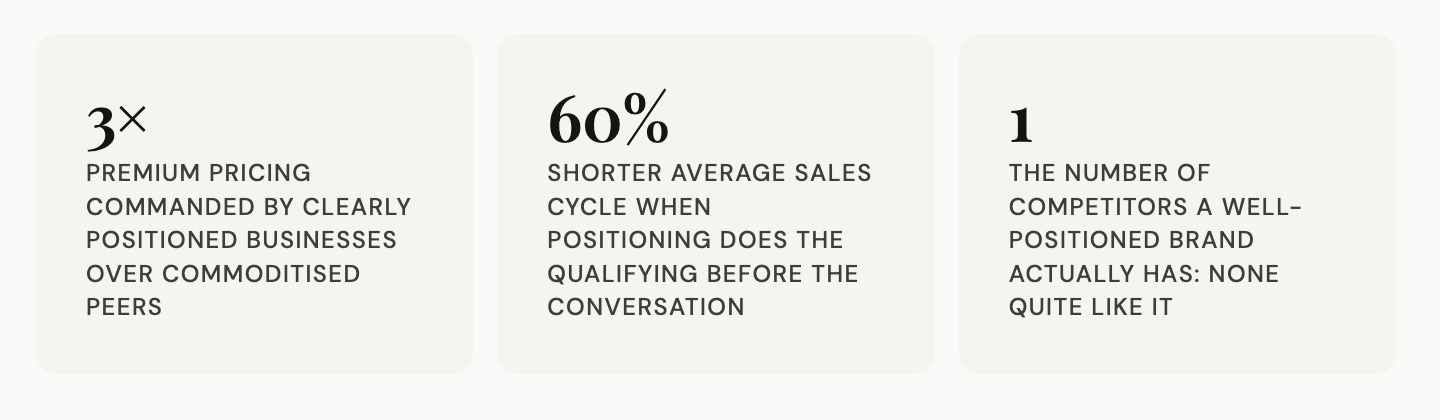
The four levers positioning pulls
Positioning affects the business at four distinct levels. Each one compounds the others. Together, they determine whether your business grows with momentum or with friction.
Lever 01
Pricing power
Price is not what the market will bear. Price is what your positioning allows. When a business is clearly positioned — when the problem it solves is specific, the expertise is demonstrated, and the methodology is named and understood — it removes itself from the comparison set. You are no longer being weighed against three other options by a prospect with a spreadsheet. You are being considered because you are the category. Category leaders do not negotiate from the same position as their competitors. They set the price. The client decides whether to meet it.
The founders who find themselves in endless fee conversations, shaving percentages and offering flexibility they cannot afford, are almost never lacking in expertise. They are lacking in positioning. The offer is real. The problem is that the business has not communicated why this particular expertise, from this particular person, is worth the number on the page.
Lever 02
Client quality
Positioning is a filter. A well-positioned brand attracts clients who are already aligned — with the methodology, with the investment level, with the seriousness of what is being offered. It repels clients who are not. Both outcomes are equally valuable. The business that has positioned itself clearly does not need to spend the first three conversations convincing a prospect that strategy matters, or that the fee reflects the outcome rather than the hours. That alignment was established before the call was booked.
Conversely, a business that has allowed its positioning to drift, that has accumulated a broad, catch-all message in an attempt to appeal to everyone, tends to attract the clients who are least sure what they need and most resistant to being led. Unclear positioning does not produce a neutral outcome. It actively draws in the wrong room.
Lever 03
Sales conversation length
When positioning is doing its job, the sales conversation is a confirmation, not a conversion. The prospect has already done the work: they have read the site, understood the offer, assessed the methodology, and concluded that this is the right move. They are arriving at the conversation to finalise, not to be persuaded. The positioned business has a shorter, cleaner, more dignified commercial conversation - because the heavy lifting has already been done by the brand.
The business without clear positioning carries the full weight of that qualification work into every sales interaction. Every conversation starts from scratch. Every prospect requires education. Every call is longer, less certain, and more emotionally costly - for the founder and for the client.
Lever 04
Competitive differentiation
In a saturated market, the greatest competitive advantage is not being better. It is being distinct. Positioning creates distinction — a specific point of view, a named methodology, a clearly articulated problem that only this business solves in this particular way. When a business occupies that ground, comparison becomes structurally difficult. A prospect cannot easily line it up against three competitors and choose on price because the positioning has made clear that this is not the same product at a different price point. It is a different product entirely.
This is the compounding benefit that separates positioned businesses from commoditised ones over time. Every client engagement reinforces the positioning. Every result adds to the proof. Every referral carries the specific language of the brand. The business gets harder to copy and easier to choose — not because the market has changed, but because the positioning has claimed a piece of it.
Why most founders defer the positioning decision
The most common reason positioning is deferred is that it feels like a risk. To position clearly is to say: this is who I am for. Which also means: this is who I am not for. For founders who have built their business through breadth — by saying yes to the interesting project, the slightly different client, the adjacent sector — that narrowing can feel like contraction.
It is not. It is the opposite. The business that knows exactly who it is for, what it solves, and why its approach is the right one for that specific problem is not smaller. It is more powerful. It has compressed its energy into a precise point rather than distributing it across a surface. That compression is what creates pricing power, client quality, and competitive differentiation. It is what allows a business to grow without the founder working harder.
The second reason positioning is deferred is that founders often conflate it with visual identity. They assume that when they are ready to reposition, they will need a full rebrand - new logo, new website, new everything - and they postpone it until they have the budget and the bandwidth. This is a category error. Positioning is a strategic decision. Visual identity is the expression of that decision. You can reposition without touching a logo. But you cannot design your way to a position you have not strategically defined.
“You cannot design your way to a position you have not strategically defined.”
The inflection point problem
Positioning is not a static decision. It is a decision that needs to be revisited at every significant inflection point in the business, when the offer evolves, when the client profile shifts, when the founder's own expertise has moved somewhere the brand has not followed.
This is the positioning problem that appears most often in established businesses: not that they never had a position, but that the business has moved and the brand has not kept pace. The founder has a decade of results, a named methodology, a track record with serious clients - and a website that still reads like the early days, when the priority was to be approachable, accessible, and affordable. The brand is anchoring the business to a version of itself it has already outgrown.
The commercial cost of that gap is real and measurable. The right clients, the ones who are ready to invest at the level the business actually operates at — arrive, look at the brand, and draw conclusions that do not match the reality. They may not say yes. They may look elsewhere for the senior thinking partner they need, because the positioning did not signal that this was the place to find it.
How to get clarity on your positioning quickly
Positioning clarity does not require a six-month process. What it requires is honest diagnostic work before strategic direction is set. There are two stages to that.
The first is assessment. Before investing in any repositioning work, a founder needs an honest read on where the current brand is falling short - not aesthetically, but commercially. Is the positioning attracting the right clients? Is it commanding the right fees? Is it communicating the actual level of expertise and track record the business has built? The gap between where the brand is and where it needs to be determines the scale of the work required.
Tools like the Brand Authority Score™ exist precisely for this stage. It is a short, structured diagnostic (just three minutes) designed to give you a clear read on where your brand authority stands across the commercial dimensions that matter: positioning precision, expertise signalling, offer clarity, and market credibility. The output is not a vague score. It is a targeted picture of where the brand is working, where it is not, and what the priority areas are for any founder who wants the business to start operating at the level they have already reached.
The second stage is strategy - the work of defining, with precision, what the positioning should be and building everything from that foundation. That is a deeper engagement: it requires thinking about the business, the market, the ideal client, the methodology, and the commercial ambition together, in the right sequence. Strategy first, always. Design is the expression of the thinking, never the starting point.
But the Brand Authority Score™ is the right place to begin. It costs nothing and takes three minutes. It will tell you whether you have a positioning problem, and how significant it is. That diagnosis is what makes the strategic work that follows precise rather than exploratory. It is the difference between knowing where you are going and wandering until something works.
The business you have built deserves a brand that is operating at the same level. That alignment does not happen by accident. It happens by decision.
Find out where your brand authority stands, in three minutes.
A free, structured diagnostic covering positioning precision, expertise signalling, offer clarity, and market credibility. The output tells you exactly where the brand is working, where it is not, and what to address first.