
There is a pattern I have seen often enough now that I no longer think it is accidental. A woman arrives at a point in her career where she is ready to build something of her own. She has the experience. She has the track record. In many cases she has held senior roles, led teams, managed significant budgets, navigated complexity that would stop most people in their tracks.
By any objective measure, she is operating at a serious level. And then she builds a website that looks like she is just starting out. The pricing is tentative. The messaging is vague. The offer is buried under qualifications and caveats. The copy reads as though she is asking permission to be taken seriously rather than stating, plainly, that she already is. This is not a confidence problem. It is a positioning problem. And it has a specific cause.
The System That Creates the Gap
To understand why this happens, you have to understand what many of these women have been through before they arrive at the decision to build something independently.
A significant number have experienced some version of the same story. A career interrupted — by children, by caring responsibilities, by circumstance. An attempt to re-enter the workforce that did not go the way it should have. A hiring system that said, in various ways and with varying degrees of directness: you are not quite what we are looking for right now.
Organisations talk about valuing experience. In practice, many hire for continuity. They choose the candidate already inside the system, already current on paper, already requiring the smallest possible leap of faith. Returners, by definition, require a larger one. And the majority of hiring structures are not built to make that leap.
The professional consequence of this is well documented. The psychological consequence is less often named.
When a system repeatedly declines to recognise your value, you begin — gradually, not consciously — to internalise that verdict. You start to soften how you describe your experience. To add qualifications where none are needed. To frame your expertise as one perspective among many rather than as hard-won knowledge that has been tested and proven.
You start, in other words, to present yourself the way the system has been treating you. And by the time you step outside that system to build something of your own, the habit is already formed.
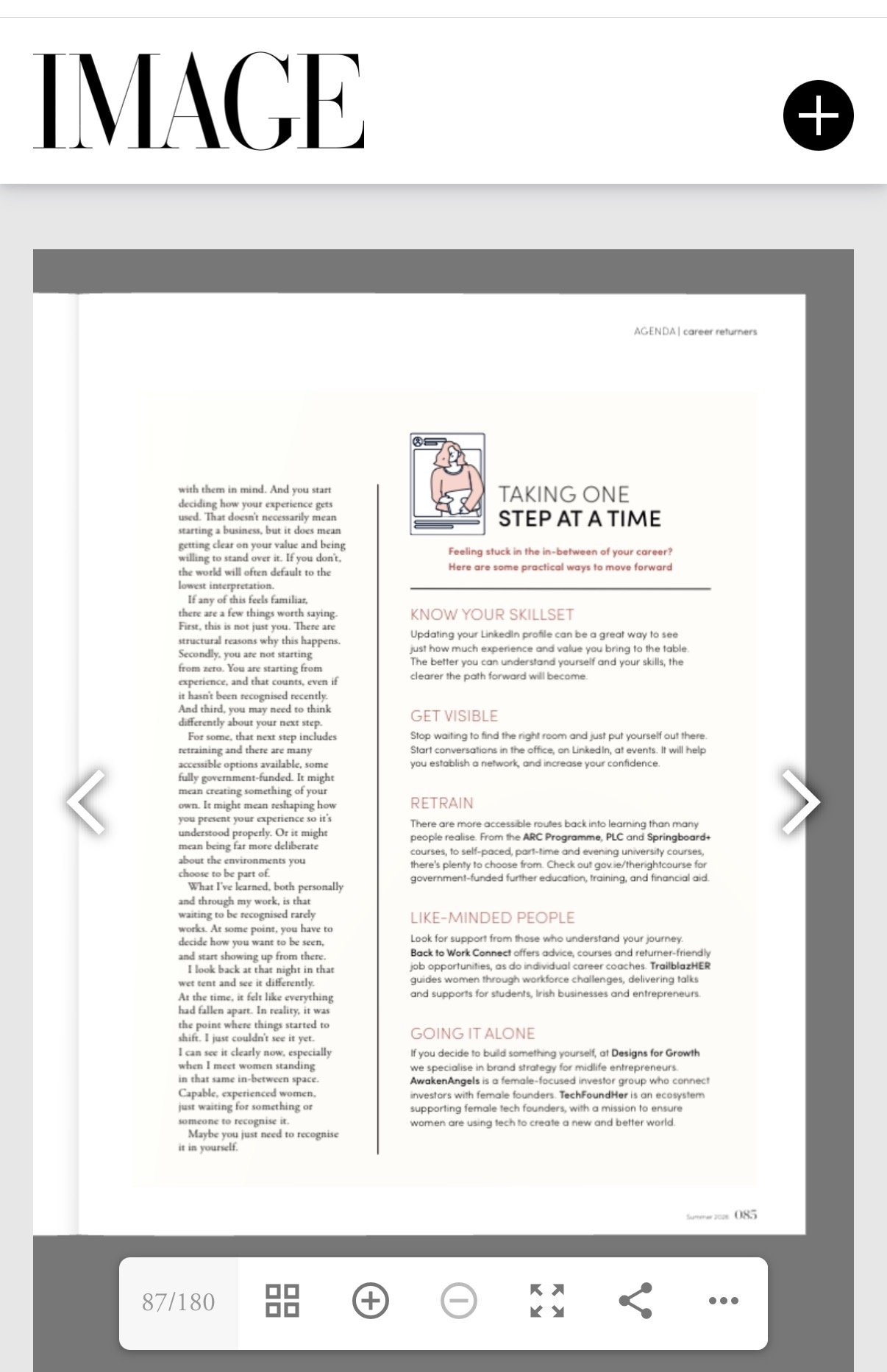
I wrote about this recently for Image Magazine, about the specific experience of trying to re-enter a workforce that had quietly decided you were no longer current, and what it takes to move past that. The personal story is there. What I want to address here is the commercial consequence that follows.
What Underselling Actually Costs
This is where the conversation usually stays practical. Work on your confidence. Update your LinkedIn. Get visible again.
All of that has its place. But it misses the more significant commercial consequence.
Because the market responds to how you present yourself. Not to how capable you are. Not to what you know. To how you show up — the specificity of your positioning, the clarity of your offer, the authority of your communication.
If your website is vague, people make vague assumptions. If your pricing is tentative, people treat the offer as negotiable. If your messaging centres on what you do rather than what changes as a result of working with you, people will not understand why they should pay a premium for it.
The gap between what an experienced woman actually brings and what her brand communicates is not just a perception problem. It is a revenue problem. It determines who enquires, what they expect to pay, and whether they take the engagement seriously from the start.
I have worked with founders who were, objectively, operating at a level that should have been commanding significantly higher fees and attracting significantly better clients. The work was there. The results were there. The brand was representing them at a fraction of the level they were actually operating.
That gap has a cost. And it compounds. Because the clients you attract at the wrong positioning level are not the clients who refer you into the rooms where the right opportunities sit.
Why the Standard Advice Does Not Fix It
The advice typically offered to women in this position focuses on visibility. Show up more. Post more consistently. Go to more events. Build the network.
Visibility without positioning is noise. It puts more of the wrong message in front of more people. It does not close the gap between how you are presenting and how you should be presenting. It simply accelerates the circulation of a brand that is already underselling you.
The other common intervention is aesthetic. A new logo. A new website. A new colour palette. Something that looks more premium, more current, more considered.
This doesn’t work either, not because visual identity does not matter, but because visual identity cannot do the job of strategy. It can make something look more expensive. It cannot make something be positioned correctly. And the difference between those two things is the difference between a brand that attracts the right clients and a brand that simply looks better while attracting the wrong ones.
What closes the gap is a documented strategic argument. A clear articulation of who this is for, what problem it solves, why this business and not another, and what the buyer needs to believe — in sequence — before they are ready to make a decision. That argument has to exist before the visual work begins. It is the foundation the visual work builds on.
Without it, you are decorating a building that has not yet been designed.
The Shift That Changes Things
The women I have seen make the most significant commercial progress share one thing in common. At some point, they stopped waiting for external structures to recognise their value and made a deliberate decision about how their experience was going to be positioned and communicated.
That decision is not a mindset shift. It is a strategic one. It requires looking honestly at the gap between the business you have built and the brand that is currently representing it, and being willing to close that gap as a commercial priority rather than a cosmetic one.
It also requires recognising that the habits formed during years of being underrecognised do not disappear on their own. They show up in the copy. In the pricing. In the way the offer is structured and sequenced. In what you lead with and what you bury.
Undoing that requires deliberate work. Strategy first. Then identity. Then communication. In that sequence, and not the other way around.
A Note on Where to Start
If you recognise any of this, if the gap between what you are doing and how your brand is representing it feels familiar, the most useful starting point is an honest audit of where that gap actually exists.
The Brand Authority Score is designed for exactly this. It takes three minutes, it is free, and it will show you clearly where your brand is working and where it is losing ground on your behalf.
If what it surfaces warrants a more direct conversation, the Brand Clarity Session is where that conversation happens. Ninety minutes. A full strategic summary. And a clear picture of what your brand needs to do differently for the business you are building now.
The experience is already there. The question is whether the brand is doing it justice.