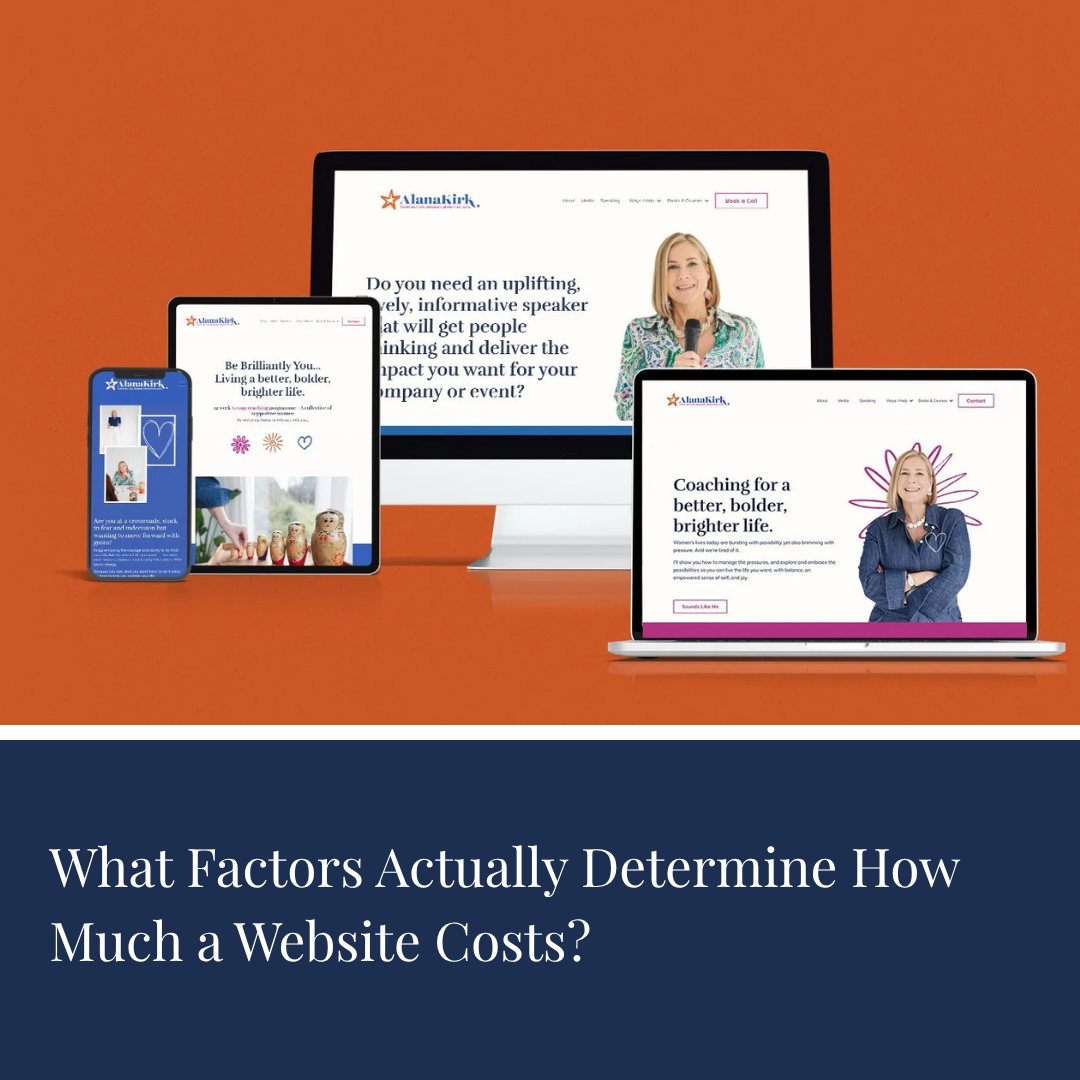
What Factors Actually Determine the Cost of a Website?
From building a new website from scratch to updating an old DIY site, it’s natural to have questions and concerns. Website cost is a big one.
You can find details about my website pricing here.
To help remove some of the guesswork and offer much-needed clarity around website pricing, let’s explore some of the main factors that impact website cost in 2025.
But first, do you really need a website?
Short answer? Yes. And here’s why…
With so many online platforms at your fingertips, it might be tempting to go without a website. After all, your social media has all the information people need, right?
Not quite.
Social media is rented real estate, meaning you don’t have 100% control over anything that happens there. In contrast, your website is the central hub of your business, where your audience can go to learn more about you, what you offer, and, most importantly, how you can help them.
Because of this, social media is best when used as a supporting marketing tool.
We recommend using social media to connect and build relationships with your audience; however, the ultimate goal is to direct your audience back to your website and move them along to the next phase of the customer journey.
Other concerns we regularly hear as professional website designers include: “I’m not tech savvy”, “I just don’t have the time”, “websites are too expensive”, or the infamous “I don’t need one; I have enough business already”.
Yep, all familiar concerns we hear regularly as professional website designers.
And we get it – creating a website can be overwhelming and costly. However, without one, you risk becoming lost against your competitors online and miss out on some pretty powerful benefits for your business.
Benefits of a website for your business
A website gives instant access to millions of users who surf the internet for hours daily. Not only that, but research has found that not having a website can actually cost businesses 70-80% of potential customers! That’s a lot of money to leave on the table, right?
Aside from attracting new customers, a well-designed website can help you:
Increase your brand visibility online through search engine optimisation (SEO) and consistent content creation
Build credibility and trust with existing and potential customers
Boost brand awareness and recognition through consistent messaging and design
Make money online while you sleep with an online platform that works for you 24/7
Create a better customer experience by providing on-demand access to valuable content & customer service resources
Types of websites
Before creating a website, the first step is deciding which type of website best suits your business needs. As a guide, here’s an overview of some of the most common website types, their purpose and key features.
Business/ Service Provider portfolio site:
Purpose: To inform prospective customers about your business and entice them to work with you
Key Features: Homepage | Services Page | About Page | FAQ | Testimonials | Contact | Booking/Scheduling Tool integration
Blog website:
Purpose: To educate or inform your audience and position yourself as a trusted authority in your field
Key Features: Article pages | Article catalogues | Categorization/ tag features | Search function | Bio/About Page
Event website:
Purpose: To plan events and consolidate helpful easy-access information for attendees
Key Features: Signup functionality | Booking/Scheduling tool | Secure checkout | Event info page
Landing Page:
Purpose: To drive customers to a single, specific action, usually as part of a greater marketing campaign
Key Features: Booking/Scheduling tool | Sign-up function | Call-to-action buttons
E Commerce website:
Purpose: To sell and promote products online
Key Features: Product Gallery | Homepage | About Page | Secure checkout | Category pages + custom menu bar | Contact Page | User dashboard | Live chat
Is it expensive to create a website?
The cost of a website all boils down to how much work is involved. And specifically, the two factors determining this are the size and complexity of your site.
This means an attractive 5-page brochure website with basic customisation will cost significantly less than a highly customised 20-page site with all the bells and whistles.
Ultimately, the more complex your website, the more it will cost.
So, what counts as complex? And what things should you consider before you begin the website process?
Here are some key factors that impact the cost of a website:
Brand positioning - Before you begin the website design process, step one is to get crystal clear on your positioning and how you will target your ideal audience. How will you position yourself in the mind of your customer?
Branding - Do you have an established brand visual identity in place? This includes things like your logo, colour palette, font etc.
Copywriting - Have you defined your brand tone of voice? Will you write the copy yourself or hire a professional?
Number of pages - Depending on the website's style, the page requirements of your site can vary drastically. As standard, most websites have the same core pages; Homepage, About Page, Services Page(s) & Contact page. This can expand to additional pages such as an FAQ page (which I always recommend), Testimonials page, Blog (another must-have) & so on.
Functionalities- What features do you need on your website? What plug-ins/ apps will you need to create a user-friendly experience for your customer? This could include things like e-commerce features, booking engines, scheduling tools, live chat widgets or custom-coded plugins.
Visual Media - Will you need custom illustrations, branded graphics, product photography, headshots or stock images?
Lead generation - Will you use a lead magnet to build an email list? If so, you’ll also likely need a thank you page, a follow-up email to send the freebie and a welcome email sequence.
Online shop - If you have an e-commerce business, how many products and images will accompany each product? How many product variables? (sizes/colours/dimensions etc.) - All this takes time to upload, adding to your budget.
Blogs - Are you transferring blogs from a previous site? Be mindful that some sites allow for the export and import of blog posts; others don’t.
URL mapping - If you’re moving from another site, your new site will need to replicate (as much as possible) your old URLs, or you’ll need to set up redirects if using new URLs.
SEO - Have you conducted keyword research? Do you know the keywords or phrases your audience is searching for? These need to be identified before copywriting work can begin and for your new site’s SEO settings in the backend.
Coding - Will you need support adding Google Analytics or a Facebook Pixel code to your new website?
Language versions- Does your site need to be translated into multiple languages to reach a wider global audience?
While some of the above may not be relevant to every business, it’s important to take the time to identify exactly what you need from your website before you begin the design or development process. Be mindful that each element can add to the overall cost of your website.
What’s the average cost of creating a website?
In one sense, asking “how much does a website cost?” is a little like asking “how much does a house cost?” The answer depends on so many variables. How many bedrooms? What location? What about style? You get the picture…
The cost to build a website can vary dramatically, from less than €1,000 to more than €10,000.
That’s a pretty big price range.
To get a more realistic view of what it could cost to design and develop your website, let’s break down some of the common costs involved:
-
Let’s dig deep into your purpose, mission and vision to unearth your USP and what sets you apart from the competition. We look at market research, competitor analysis, customer profiling and a product suite that your customers will love.
Starts from €2,750 + vat for 5 sessions.
Read more here.
-
We follow on from your Brand Positioning work to design a visual identity that resonates with your ideal customer and which communicates your brand personality. Logo, colour palette & typography start at €1,950 + VAT
Read more about visual identity design here.
-
1 page website with 4-5 sections to introduce your business, connected to your domain and optimised for search (as much as you can optimise a one-page site!)
Fee: €950+vat
-
This can range from headshots and product images to location shots
From €650 + VAT (mini shoot) - €2,000 + VAT (full day shoot)
-
Everything you need to take your business to the next level: positioning, branding, new website, copy polish, SEO , brand photography shoot….just €5950+ vat. Group of 4 entrepreneurs at a time. Read more here.
-
5-7 pages, without ecommerce
Doesn’t include copywriting, custom photography, or stock imagery research
Starts at €3950 + VAT
Read about our web design services here.
-
Upload and pricing for physical, digital or service-based products
Checkout function
Shipping info
Payment Processor integration
Abandoned Cart Email set-up
Email automation
Fee depends on scope.
-
Brand tone of voice development & copy for all pages of your website
Can vary depending on the copywriter. Expect to pay at least €250 + per page, plus vat
-
All above + LMS set-up on the chosen platform, e.g. Kajabi
Price depends on scope but typically starts at €4500+vat for a website and online course set-up.
-
Lead magnet design & implementation
Email sequences
Starts at €750+ vat
Please note: The above pricing is for estimate purposes only. We provide custom proposals and quotes to each client following a full consultation. You can also view our pricing guide here.
Other costs to consider
Domain name/ hosting fees (GoDaddy, Register365 etc.)
Website host/platform subscription costs, e.g. (Squarespace, Wix, WordPress etc.)
Third-party app costs (Zoom/Calendly/Acuity/Zapier/LMS fees/email marketing app monthly fees)
Payment processing fees, e.g. Stripe, PayPal, Square for online checkout, subscriptions or memberships.
Legal consultancy fees involved in creating custom privacy policies, T&Cs, website disclaimers etc.
Ongoing website maintenance costs to keep your site safe, secure and up-to-date (not necessary if you are using Squarespace or Kajabi)
Can I get funding to cover some of my web design costs?
If you are based in Ireland, the answer is maybe. The Trading Online Voucher scheme is now gone but the Grow Digital Fund may be able to help.
Should I hire a professional or DIY my website?
Hire a professional.
Yes, I’m biased, but I’m also being honest.
Creating an effective, professional website that generates real results for your business is way more challenging and time-consuming than most business owners realise.
Of course, if funds are tight right now, and the DIY approach is your only option, then do the best you can with existing resources.
However, if you are in a position to invest in a professional, hiring an experienced website designer to create or redesign your website will save you tons of time, money and headaches in the long run.
It’s the same reason we pay dentists, mechanics, accountants, and hairdressers for their expertise. They can usually get the job done quicker, more efficiently, and with results far outweighing anything we may achieve alone.
Ready for a new website?
Running a small business involves many surprises and can often incur unexpected costs. But website pricing shouldn’t have to be one of those.
As a standard, my clients can expect detailed quotes, transparent pricing and fully customised proposals based on their specific business needs & goals. Yep, that means zero hidden fees and a website designed for conversion.