
Guide to Email Marketing
A client got in touch this week to ask how he could share a 14 page guide he had written on LinkedIn. He had spent many hours carefully crafting the guide and was keen to ‘get it out there’. I was thrilled that he is creating great content for his audience and I had two recommendations:
Instead of posting a pdf on his website, paste the content directly onto his site, in the form of a blog, so that it can be found by Google. Google can’t read a pdf. A blog post also allows for feedback in the comments area, thus generating a conversation between my client and his audience.
By all means offer the Guide as a pdf, but at least get an email address in return, so that he can keep in touch with the person who downloaded it and add them to his email list.
Or better still, put the Guide on his website but also offer it as a free download, in return for an email, for those who want to keep a copy or don’t have time to read the blog post there and then.
In the end my client was in a hurry, so he created a blog post with nothing more than a short intro and a button to download the pdf and then he linked his LInkedIn post to the blog url. It remains to be seen how many people click on the link in the LinkedIn post and proceed to download the pdf from the website, but the unfortunate thing is that my client won’t know who did. If he had linked the whole thing to his email subscriber list, he would not only know who had downloaded it, but he could follow up with another email providing more useful content on the same topic and so on.
This story prompted me to write my own guide - below- to email marketing.
What is Email Marketing and Why Is It Important
Email marketing means communicating directly with your audience via email, usually via a newsletter or email sequences related to product launches or other announcements. The advantage of email marketing is that your return on investment is considerably higher than other marketing channels, such as social media or paid advertising.
Email marketing gives you direct contact with your audience, from your outbox to their inbox and research shows that engagement with subscribers on your email list is much higher than your followers on social media.
How to get started with email marketing?
Your website is the obvious place to get started when growing your email list. A sign-up form in your footer means it will appear on every page, but Brian Dean from Backlinko recommends adding a sign-up form to your about page, as it is generally one of the most visited pages on your site.
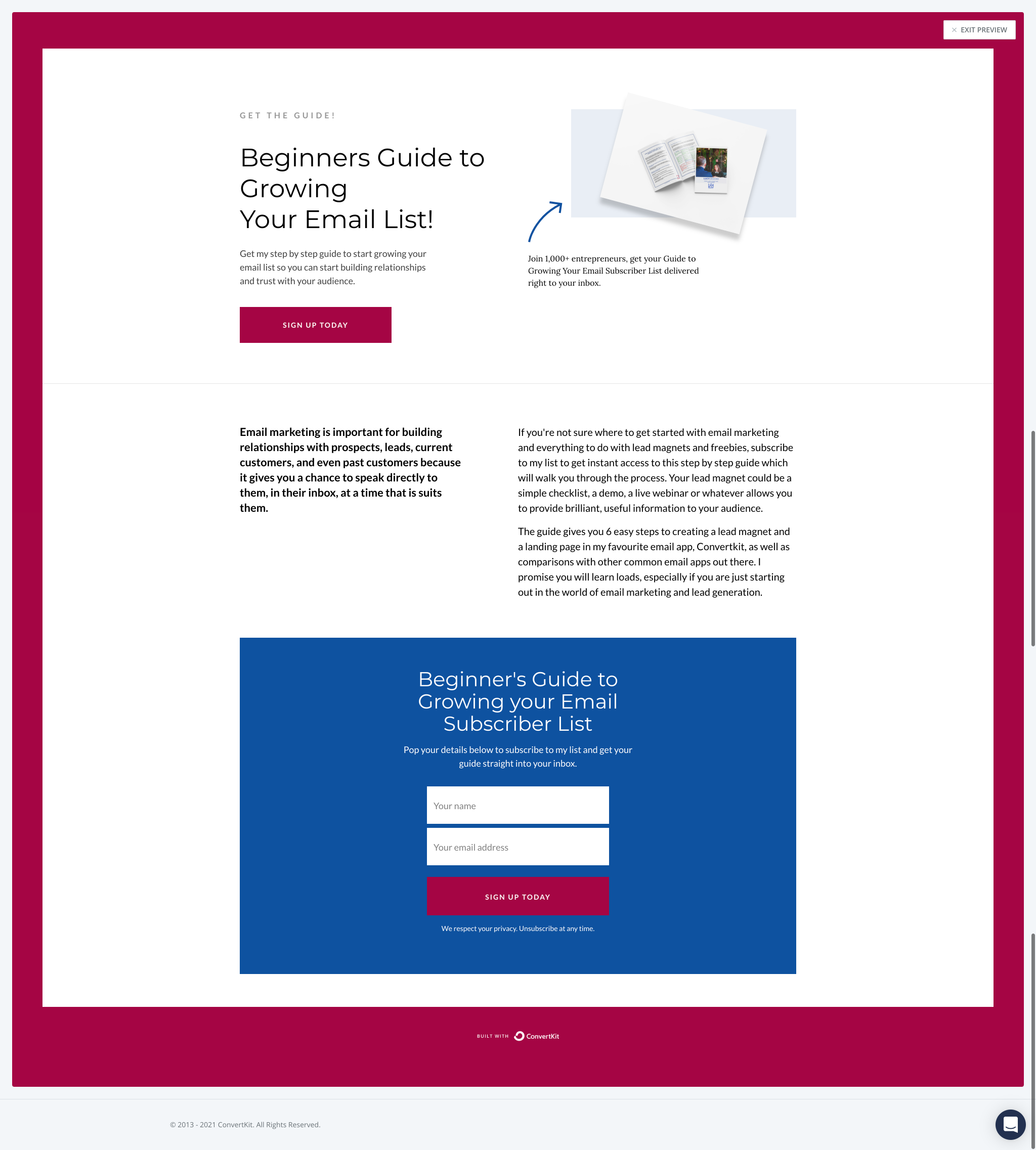
Landing pages specifically for the purpose of gaining subscribers is also a good idea, as they present no other distractions other than to get people to join your list. Here is an example of a landing page I have with this sole purpose.
Lead Magnets
You’ll notice that on that landing page, I offer what we call a Lead Magnet to entice visitors to subscribe to my list. So what is a Lead Magnet? A Lead Magnet is a something that you give away for free to your audience, in return for their email address. It could be
a downloadable guide
a free demo or audit
access to a webinar or other pre-recorded content.
The important thing is that it is valuable to your audience and illustrates your authority in your field or highlights the quality and benefits the products you sell. So, when thinking about your lead magnet, put your ideal client at the forefront of your mind and think about what you could do to make their life easier or solve a problem for them.
Converting Blogs into Downloads, to Grow your Email List
Another option for a lead magnet it to offer a pdf of a particularly popular (and long) blog post as a free download at the top of the post, in return for an email address. You can also offer it again at the bottom of the post, so the reader can keep a copy handy in their inbox.
What to write in your newsletters
Once you’ve started building a list, the next trick is to know what to put in your newsletters?
This is something I struggle with but as I increase the regularity my newsletters I am realising that there are different categories of newsletter and each one has a different purpose.
Sharing a new blog post
When we write a blog post, of course we hope that Google will pick it up, but we also want to share it with our audience. We can do this via social media, of course, but we can also share it with our email list, to provide useful information to our followers but also to encourage clicks back to the article (Google likes these clicks!).
Your newsletter subject line is important in determining the open rate of your email and in this instance, I suggest using the title of the blog post as your subject heading.
Then, give the context for what prompted you to write the blog post and offer a few bullet points about what the reader will learn in your post, followed by a button or a link to read the full article.
Making an Announcement
Say you wanted to announce a new product, a course or service, then your email has a different purpose than the Blog Post share. This time, your email subject could say something like “Announcing: My New Online Course”. You would then follow this with an introduction to your new course, some bullet points outlining the benefits of the new course (or product) followed by a clear CTA (call to action) directing the reader to your sales page for your new service.
Sharing Valuable Content
Some newsletters have no purpose other than to share useful information with your audience. There’s no Call to Action at the bottom, you are not hoping your audience will click on anything or buy anything. These newsletters are are what your audience signed up for in the first place. They don’t want to be sold to (even if they know they probably will be at some point), they have signed up to your newsletter because they think you’ll be able to help them/solve a problem/make their life easier in some way. The hardest part of writing this email is coming up with a compelling subject line as you need to pique the reader’s curiosity. You also need to have a good opening line of the email, to grab the reader’s attention (a story or anecdote works), followed by a handful of actionable tips or steps for the reader to follow. This type of email is an opportunity to ask for feedback - which gives you fodder for future content creation - as you can ask the reader which tips they are going to try or what experience they have with the topic you are writing about.
Getting Feedback via a Survey
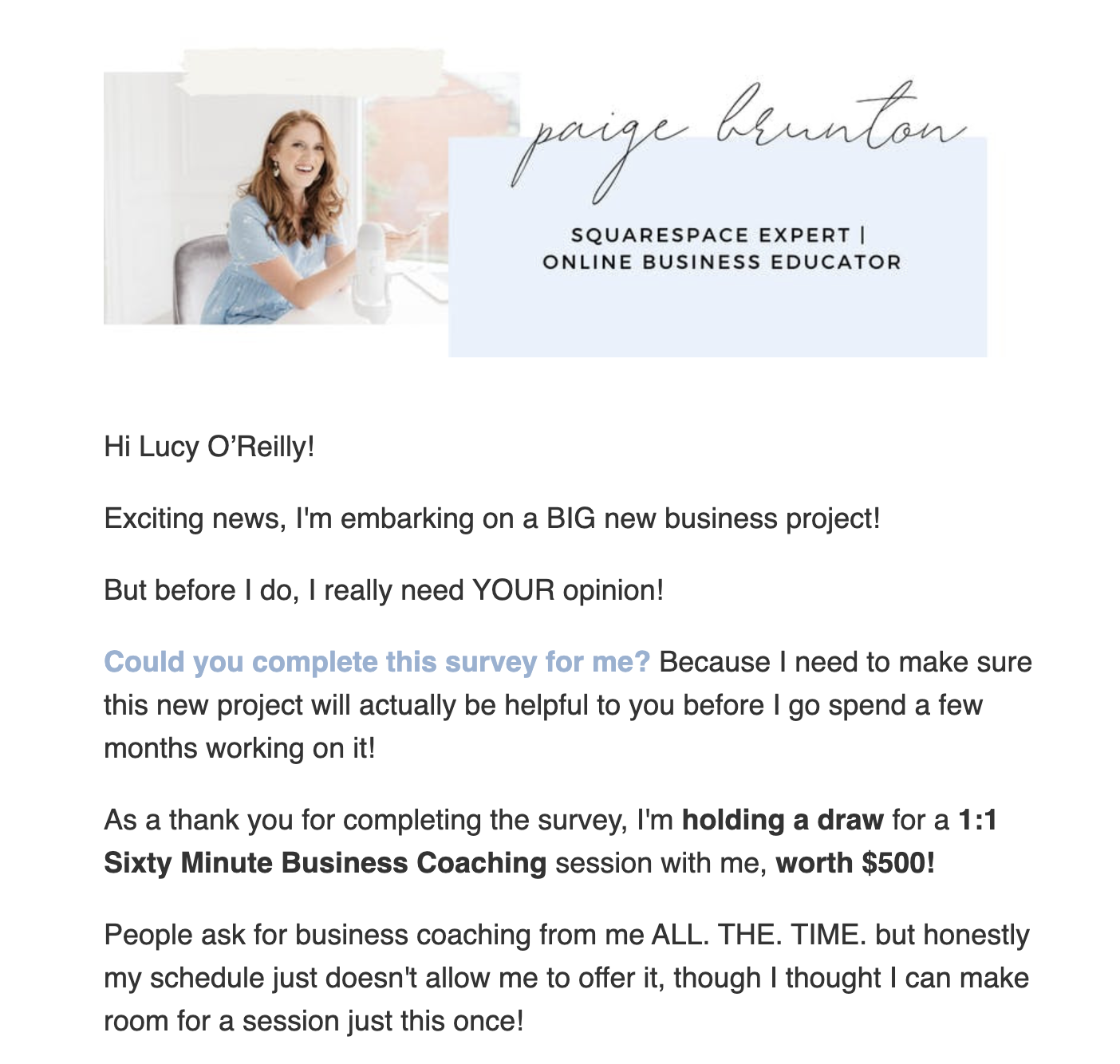
If you have a new product or service in mind and would like to test the idea with your audience first, you can use your newsletter to send out a survey or questionnaire. The key is to engage the reader and give them an incentive to take the survey. The incentive could be entry into a draw for a prize, demo or free consultation.
The survey itself could be a questionnaire on a hidden page on your website or you could simply link to a Google form or Survey Money questionnaire.
Here’s an example from Paige Brunton that recently landed in my inbox:
Write an Interesting Welcome Email
This is an oft-neglected email to your new subscribers. It’s the one they get asking them to confirm their subscription (which is recommended for GDPR reasons) and welcoming them to your list. Often these emails say something very basic like “Thanks for Subscribing, I appreciate you joining my list.”
In fact often I see businesses being apologetic about the fact that they are trying to grow their email list and are a bit too grovelly in their thank you email. They say things like “I promise I won’t bug you in your inbox every day” or “I rarely send my newsletter out, but will only send you good stuff”.
I think it’s better to get straight to business and provide value to your new subscriber from the get-go.
Here’s an example of a new subscriber email I received from Benji at Grow and Convert :
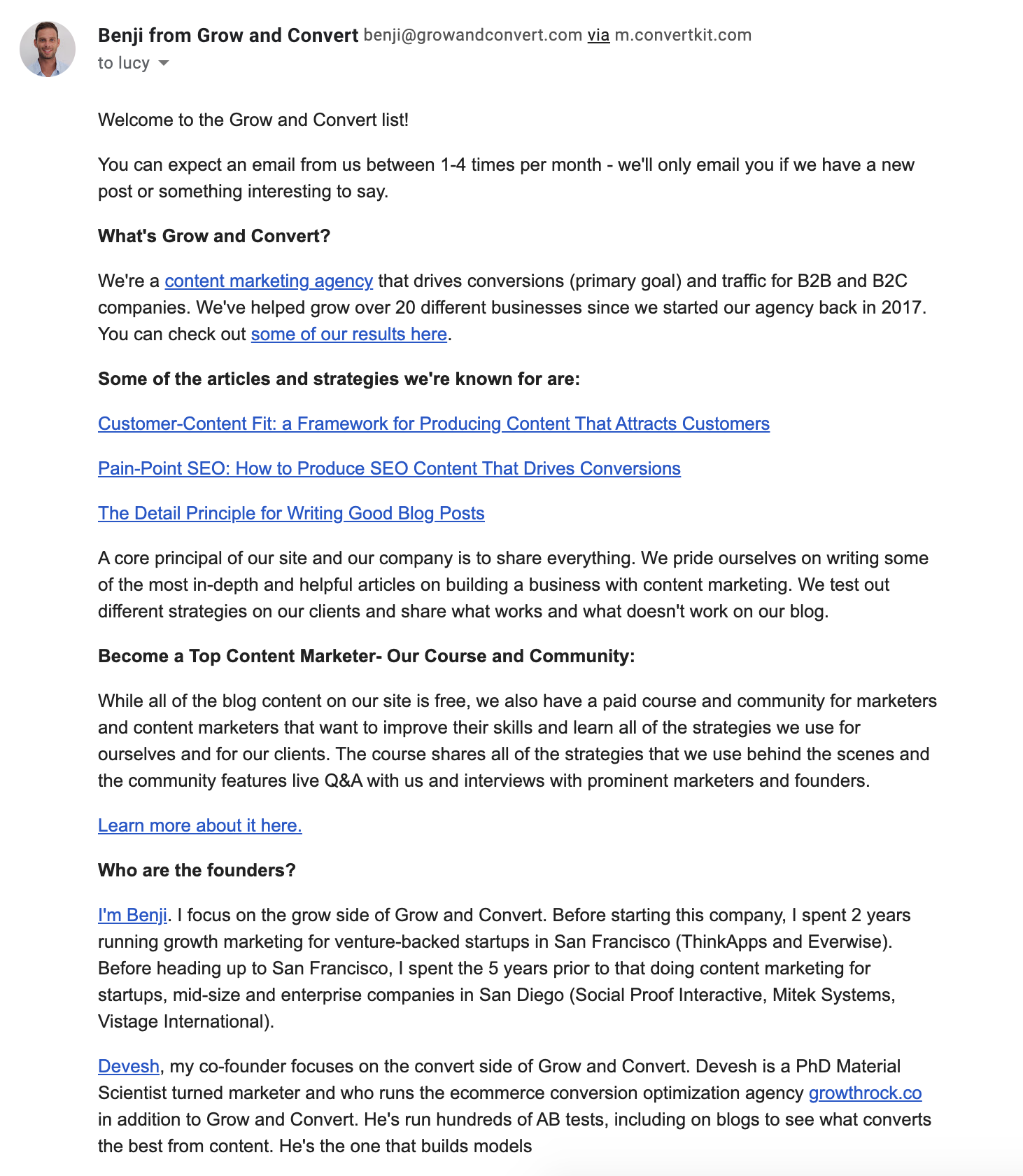
See what he did? He presented the company briefly, gave me useful links to great content that I might be interested in (creating backlinks for their website at the same time), introduced the founders and then…
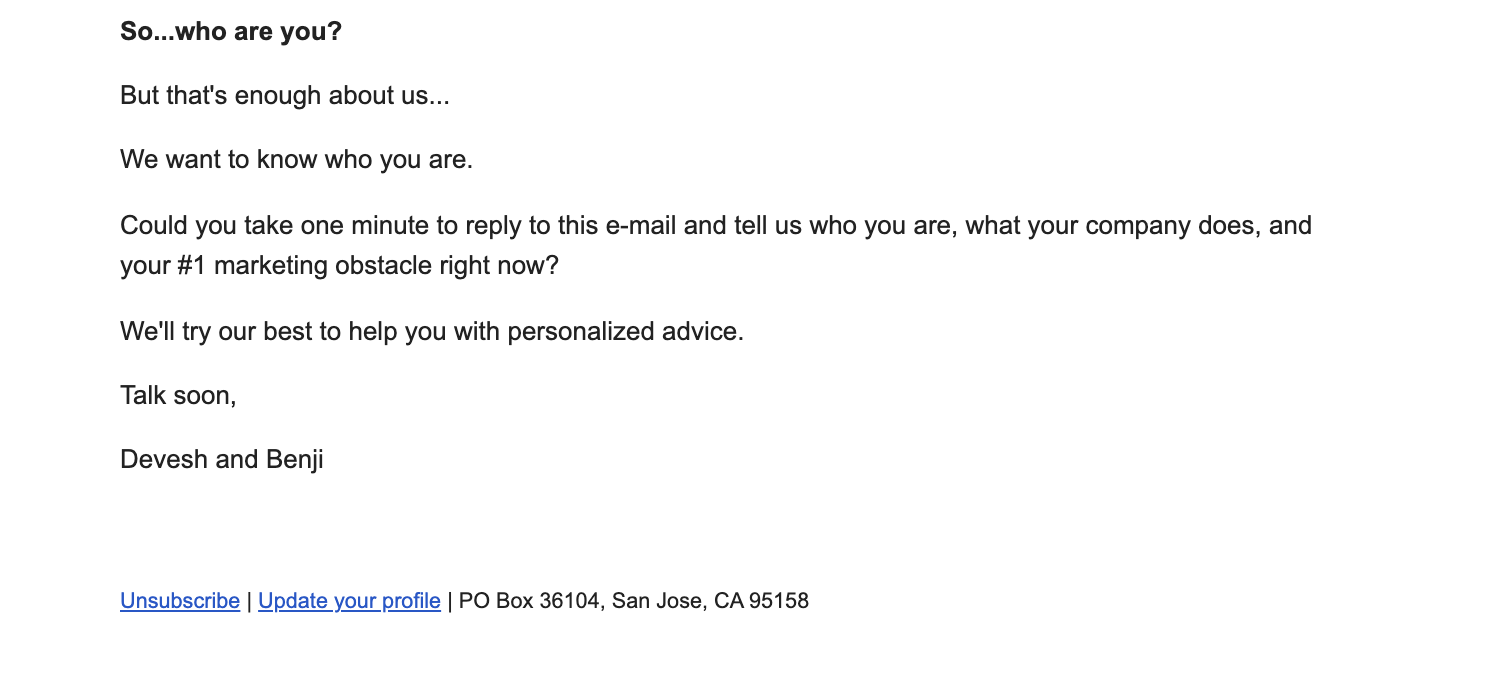
By asking for feedback from the reader they are getting fodder for future content because they will have insights into what marketing obstacles their audience is facing. I have updated by own welcome email in a similar vein, so I’ll let you know if engagement increases!
Ensuring Your Newsletters Get Opened - Email Deliverability
Once you’ve taken the time to write your newsletter, you want to ensure it gets into your subscriber’s inbox. Convertkit has a great guide to email deliverability, but in short, here’s what you need to know and think about:
Write great content so your subscribers will love getting your emails. The more engaged your subscribers are, the better your email deliverability will be. By engaged I mean, they are not unsubscribing but rather are opening your emails, clicking on internal links or purchasing something from you.
Avoid spammy subject lines. Gmail and other Email Service Providers are always on the look-out for spammy emails, in an effort to protect their customers from spam. There are common spam words that they tend to block when they find them in subject headers. For example:
Free | Financial freedom | Make money online | Credit card offer | Apply now | €€€ | Order now | Price | Increase sales
You can use this free subject line tester to help you create click-worthy subject lines.
Make it easy to unsubscribe Don’t worry if you lose subscribers, they probably were never going to do business with you anyway. You don’t want a bloated list of subscribers who have no interest in your product or services, so be happy when they bow out - and make it easy to do so. The footer of your email is the obvious place to put the unsubscribe link as that’s where we expect to see it. Don’t make your reader search for it.
Create lead magnets for your target audience, not to simply grow your list. It takes time to create a valuable lead magnet or freebie, so make sure you are creating the ones your target audience wants. There’s no point attracting the wrong type of customer to your list.
Ask subscribers to move your emails from their spam or promo folder to their inbox. Sometimes your newsletter lands in your subscribers’ spam folder, for reasons you cannot control. By asking your subscriber to move your email to their inbox, this signals to their email service provider that emails arriving from your email belong in their inbox, not their junk folder.
Voilà, I hope you found this useful. Follow these tips and you’ll see your lead generation increase. As I say to all my clients, it’s about creating value - whether on your blog or in your newsletters. Create value and your customers will come. Use email marketing to stay in touch with them and nurture the relationship.
Leave me a comment below if you have any thoughts or comments you’d like to share!